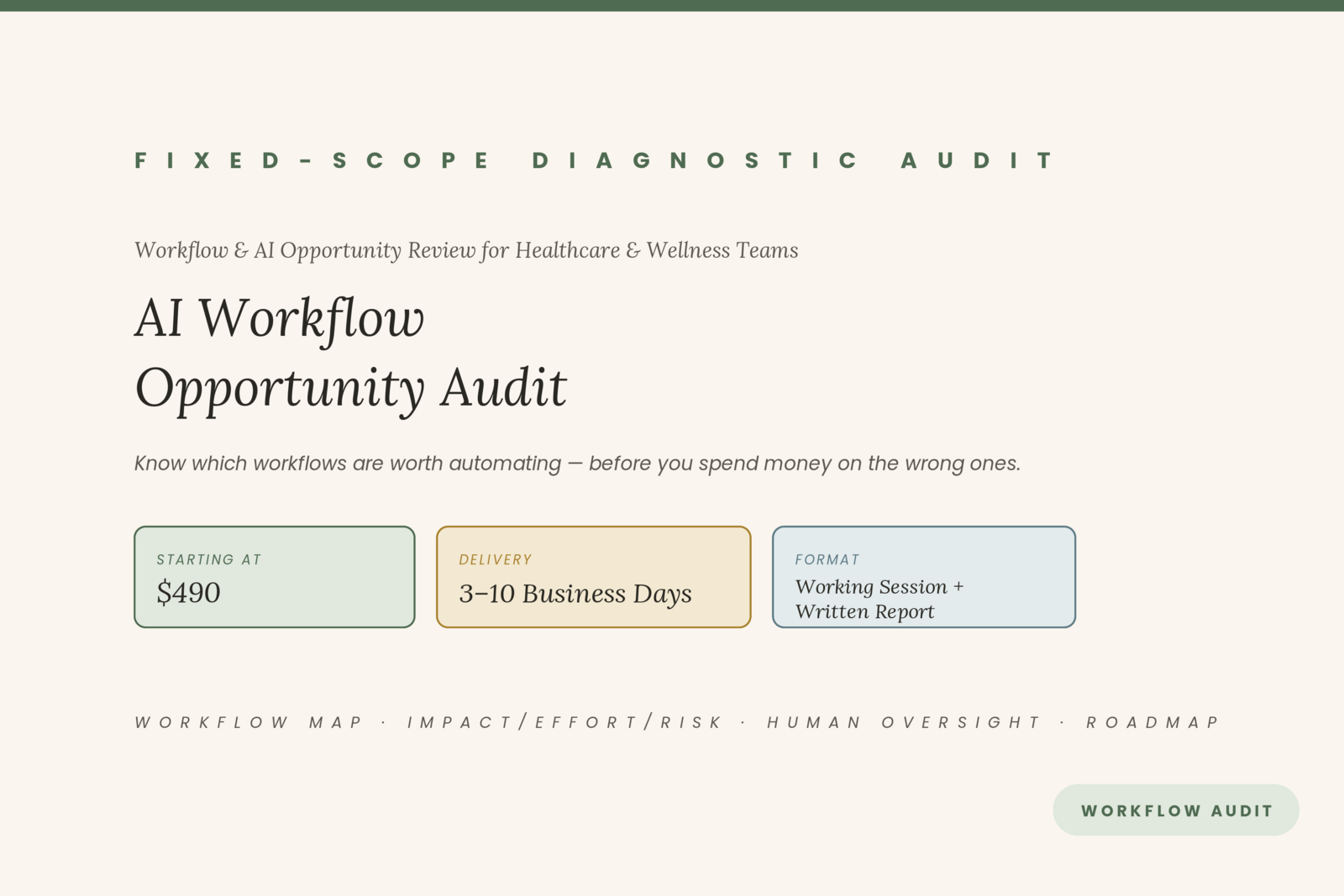
AI Workflow Opportunity Audit for Healthcare & Wellness Businesses
Know which workflows are actually worth automating — before you spend money on the wrong ones.
Your team is probably already experimenting with AI somewhere — a chatbot here, an automated email there. The real question isn't whether to use AI. It's which of your workflows are actually worth automating, and which ones aren't. This audit gives you a clear, prioritized answer, based on how your organization actually works today.
A prioritized answer, grounded in how you actually work.
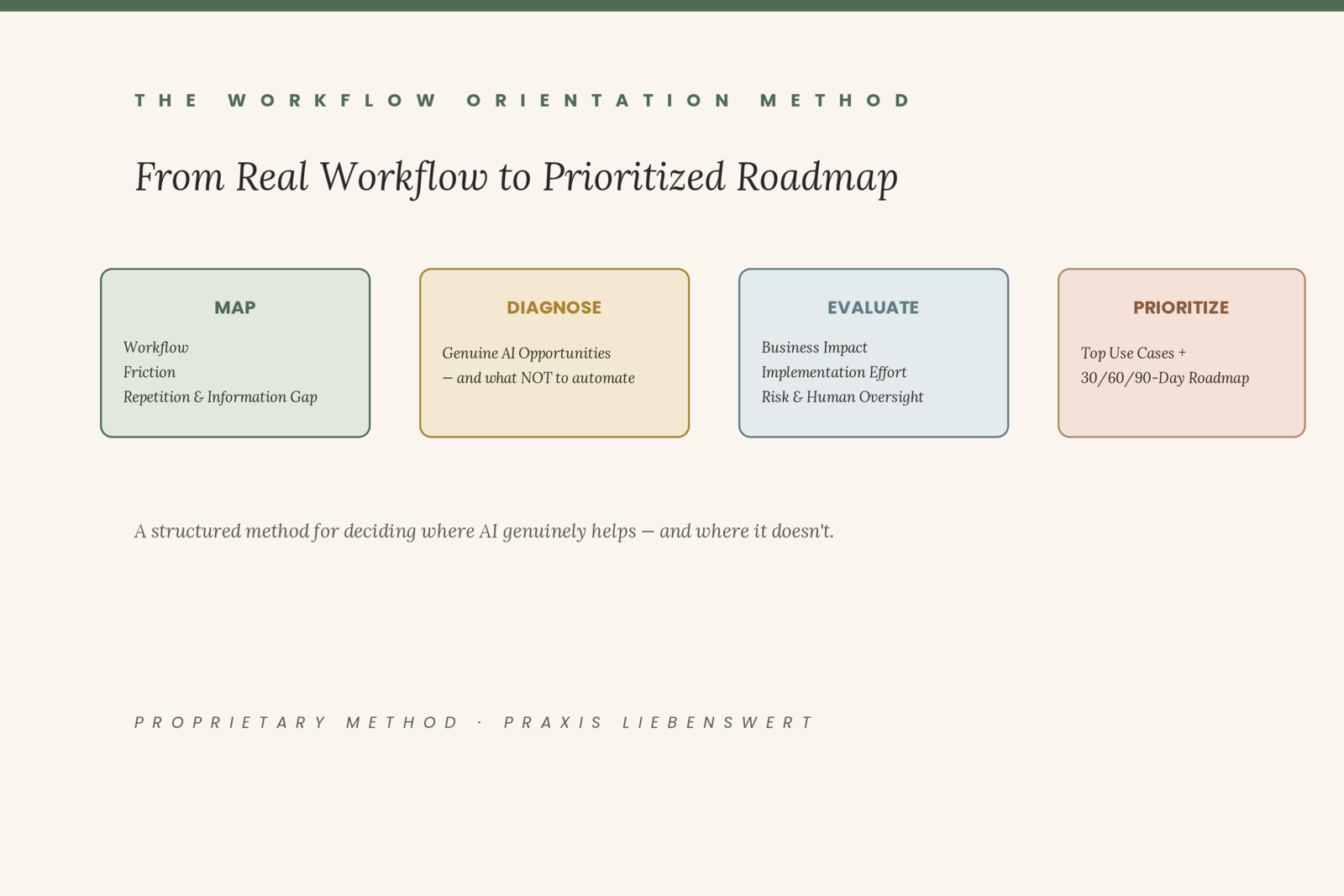
I map how your real workflows actually run today — where time and effort go, where information gets stuck, and where the same manual steps repeat. From there, I identify genuine AI opportunities, flag the ones that aren't worth pursuing, and score what's left for business impact, effort, and risk — including exactly where a person needs to stay in control.
Impact estimates are grounded in the workflow information you provide, not generic industry benchmarks or invented time-savings figures. You get a prioritized list of opportunities, a clear view of what to leave alone, and a 30/60/90-day roadmap you can act on.
Understanding how work actually flows — not enterprise AI engineering.
This is a strategic audit, not a technology build. I don't come from an enterprise AI-engineering background — I come from designing information architecture, orientation systems, and editorial workflows for sensitive healthcare communication, including running my own AI-assisted editorial operation for my platform, Praxis Liebenswert.
That background is what this audit uses: understanding how work actually flows, and where AI genuinely helps versus where it would just add noise. If you already have an engineering team, this audit gives them a validated, prioritized starting point instead of guessing where to spend engineering time first.
Pick the depth that matches your decision.
Find Your Strongest AI Opportunity
$490
- One structured 60-minute working session
- Up to 3 candidate workflows discussed
- One clearly prioritized AI opportunity, with reasoning — plus a short note on others considered
- Written summary (1 page)
Delivery: 3 business days after the session
Prioritize AI Opportunities Across Your Workflows
$1,290
- Structured intake + up to 4 workflows analyzed
- Workflow-by-Workflow Assessment
- Prioritized AI Opportunity List (impact / effort / risk)
- Unsuitable / Low-Value AI Use Cases — what NOT to automate, and why
- Human Oversight Checkpoints
- Tool-Category Landscape
- 30/60/90-Day Roadmap + Executive Summary
- 45-minute results call
Delivery: 7 business days · 1 revision round
Build Your Organization-Wide AI Roadmap
$1,890
- Structured intake + up to 6 workflows analyzed
- Everything in Core, at greater depth
- Cross-workflow patterns and organization-level prioritization
- Expanded Tool-Category Landscape
- Detailed 30/60/90-Day Roadmap
- 60-minute results call
Delivery: 10 business days · 2 revision rounds
One trigger, one outcome, usually one role.
A workflow, for this audit, is a single, repeatable process with one clear trigger and one clear outcome, usually handled by one role or a short handoff between two roles — for example: “a new patient inquiry arrives → gets logged → gets answered.”
It is not an entire department's work. If a process has more than one real entry point, more than 2–3 major stages, or more than 2 handoffs between people, it counts as more than one workflow for this audit.
Before analysis begins, we confirm together in writing exactly which workflows are in scope for your package. If multiple people in your organization want to propose workflows, that's fine — send your combined shortlist during intake, and we'll help narrow it to the number included in your package.
A short, structured starting point.
- Completed intake questionnaire
- A one-sentence description of each candidate workflow (trigger → outcome)
- Anonymized or hypothetical workflow examples only — no real patient data
- A point of contact for the results call (Core / Advanced packages)
Diagnosis and prioritization — not implementation.
- Maps your real workflows and where time and effort are actually going
- Identifies genuine AI opportunities — and where AI would add risk or complexity instead of value
- Prioritizes opportunities by business impact, effort, and risk
- Flags where human oversight must stay in place
- Points you to the right category of tool or approach for each opportunity
- Hands you a 30/60/90-day roadmap you can act on immediately
What It Does Not Include
- Software implementation, custom coding, or API development
- Automation building or system integration
- Legal, compliance, or GDPR certification
- Vendor selection or procurement negotiation
- Medical, clinical, or safety certification decisions
Implementation is a separate, well-informed next step — this audit is what makes that next step worth taking.
What's your background in AI, specifically?
I'm not an AI engineer or automation developer. My background is information architecture and editorial workflow design for sensitive healthcare content — including running my own AI-assisted editorial operation. This audit uses that same skill.
Will this include implementing the AI you recommend?
No. This audit delivers a prioritized roadmap. Implementation — whether by me, your team, or a developer — is a separate, well-informed next step. If you already have an engineering team, this gives them a validated starting point.
Can I share real patient data as part of this process?
No. Please describe workflows using anonymized or hypothetical examples only — no real patient data. This keeps the audit simple, fast, and free of compliance risk on both sides.
How is this different from your GEO Audit or Health Content Audit?
Those two look outward — at how people find and understand you. This one looks inward, at your own team's workflows and where AI could genuinely help.
Do you provide legal, GDPR, or compliance certification?
No. I flag where a workflow touches sensitive data or regulated decisions, so you can bring in the right specialist — but I don't provide that certification myself. This is operational guidance, not legal advice.
Do I need technical skills to act on the roadmap?
No. The roadmap is written for business decision-makers, not developers. If you have a technical team or partner, they can take it from there — but you don't need one to understand it.
Operational guidance — not a substitute for compliance review.
This audit evaluates workflows from an operational and strategic perspective — where AI could help, where it shouldn't be used, and where a person needs to stay in control. It does not replace legal, data-protection, or compliance review. Where a workflow touches sensitive data or regulated decisions, that's flagged clearly so you can bring in the right specialist before moving forward — the same way I'd flag it for my own work.
Three independent, focused audits for healthcare and wellness organizations.
Health Content & Orientation Audit
Does your content actually help people understand and act, once they find you?
AI Workflow Opportunity Audit
Is your team's own time and effort being spent where it should be, and where could AI genuinely help? (This audit.)
If you're not sure which workflows are actually worth automating — or which ones aren't — let's find out before you spend money on the wrong ones.
Send a message to get startedIndependent platform · Founder-led · Fixed-scope diagnostic audit.